
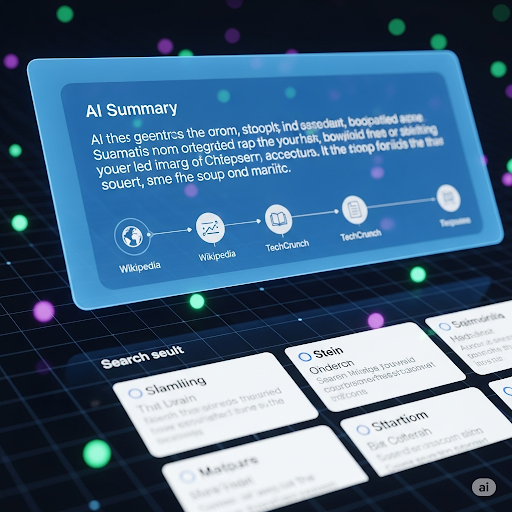
The revolution in search results: why SGE is the future of SEO
If until now SEO was based on a battle for the “10 blue links” on Google’s first page, the rules have changed. Meet the Search Generative Experience (SGE) – the newest and most significant revolution Google has introduced in a decade. We at WSO believe that understanding SGE isn’t just an advantage, but an existential necessity for any site that wants to survive and thrive in the digital landscape of 2026 and beyond.
So what exactly is SGE?
Instead of a simple list of links, SGE gives an answer. It’s a comprehensive, AI-based response displayed at the top of the search results page. Google takes data from many sites, summarizes it into short, clear text, and gives the user the answer they’re looking for without them having to click on any link. It’s no longer just a question of “where do I appear?”, but “is my information included in Google’s full answer?”.
SGE’s impact on SEO: a challenge and an opportunity
Some see SGE as a threat to organic traffic. If a user gets the answer directly on the search page, they won’t click on our site. It’s an excellent question, and it leads us straight to one of the biggest opportunities. We at WSO don’t see it as a threat to SEO, but as a change of direction: the goal of organic SEO is shifting from ranking to being used.
Our challenge is to make sure our content is high-quality and relevant enough for Google to choose to include it in its generative answer. If your information is shown as part of Google’s summary, you present your brand as an authoritative source. That fact alone is worth more than any traffic.
Content strategy in the SGE era: how do you become part of the answer?
To succeed in the SGE era, we need to produce content Google can easily “digest” and summarize. This requires a fundamental strategic shift.
1. Building AI-optimized content
Artificial intelligence loves structure. For Google to use your content, you need to make it easy. How do you do it? Use clear headings (H2, H3), bullets, numbered lists, tables and question-and-answer (FAQ) sections. These formats let the search engine identify key points and summarize them quickly and reliably.
For example: Instead of writing a long paragraph on how to plan a family trip to Berlin, write a heading: “5 must-visit places in Berlin with kids”, and immediately follow it with a numbered list of the places.
2. Emphasizing E-E-A-T
Google gives top priority to content from trustworthy, proven sources. Show Google your Expertise, Authoritativeness, Trustworthiness and Experience. How do you do it?
- Expertise: Include a professional bio for your content writers.
- Experience: Weave in personal stories. For example, a travel blogger can write: “After visiting Plitvice Lakes at the height of the season, I discovered it’s better to arrive at sunrise to avoid the long lines.” This is knowledge that doesn’t appear on Wikipedia, and it proves real experience.
3. Focusing on long, conversational questions
SGE is designed to answer complex queries. It understands search intent. Instead of focusing on single keywords like “SEO”, focus on the questions people actually ask. For example: Instead of an article on “health insurance”, write an article on “how do you choose a health insurance policy that suits the needs of a family with three children?”. It’s a long, precise search that’s likely to be answered in SGE.
4. Building topical authority
SGE prefers sites that are the ultimate source on a particular subject. Create a comprehensive body of content around a central topic. For example: If you write about trips to Norway, don’t write just one article. Write an article on cruises, an article on the most beautiful trips in the north, a guide to the northern lights, and more. This establishes you as a comprehensive knowledge source.
The revolution is already here: how to prepare with us for the new era
SGE isn’t just a passing trend – it’s a deep change in the way Google works. Now the goal isn’t just to be better than your competitors, but to be the best source. Our team at WSO is leading the change and helping businesses navigate the new digital landscape successfully. We know how to create content that AI loves and how to promote sites in a way that ensures they’re included in Google’s answer, instead of fighting for a place outside it.
In practice, what’s important to understand is that the actual work of SEO doesn’t change much even with AI. We still produce large amounts of content (and handing it to AI without oversight isn’t a good idea at all), and what we do in SEO today is what we’ve done until now, with some slight adjustments for AI.
Some companies are even bringing employees back to work after a few AI blunders, as described in the article here.
Want to be ready and join us?
Leave your details and we’ll get back to you with a free professional consultation, so together we can build an SEO strategy tailored especially to your brand.