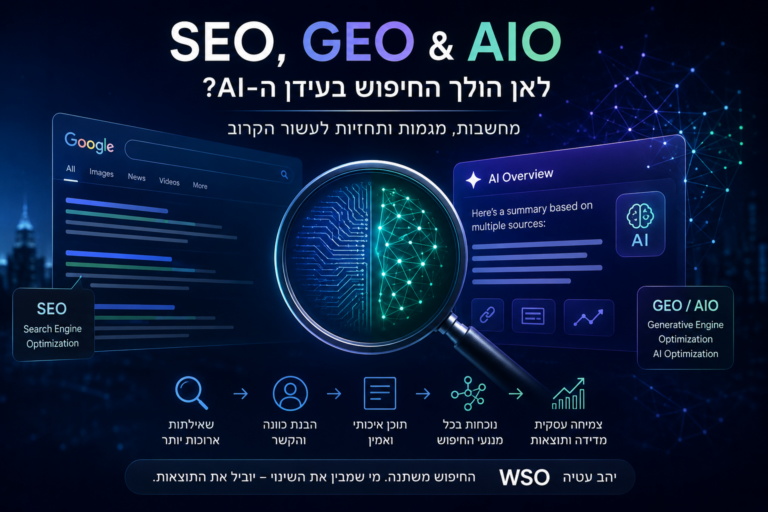
How is AIO changing the rules of the game in marketing?
Once, if you were looking for something online, the action was automatic: you went to Google, typed your question and got a list of sites. But in the last year, something changed. New players like ChatGPT, Claude and Gemini entered the market. They no longer show a list of links; instead, they give a direct answer. How does this affect your business and the way you reach customers? It’s a question everyone should be asking.
People want answers, not links
People today are looking for a conversation, not a list of sites. According to research, the use of tools like ChatGPT has reached hundreds of millions of users. People use them to write emails, plan trips and even ask for help with homework. The reason is simple: they want a direct, precise and concise answer. It’s convenient and fast, and it feels personal.
Instead of searching for “Italian restaurant in Tel Aviv”, users ask: “Find me an Italian restaurant in Tel Aviv with vegan options and delivery”. Where such a search was once complicated, today artificial intelligence can provide an immediate answer.
But does that mean Google is becoming obsolete? Not at all.
Google is still the king of search
Despite the excitement around the new tools, Google keeps its place as the leading search engine, and it will probably stay that way for a long time. Most searches are still focused and meant to perform a specific action: navigational searches (“Facebook”), business searches (“customer service phone number”) or quick lookups (“weather in Tel Aviv”).
Nobody will go into ChatGPT to check the weather or find their insurance company’s phone number. It’s faster and more efficient through traditional search. The excitement around AI may calm down, but the need for fast, goal-oriented search will always remain. Most people find change hard; there’s excitement, just as there’s excitement about anything new, but there are also many question marks raised by AI tools.
Is it a tool that saves time? Absolutely. At the same time, it’s starting to have its own problems too. And as we saw with Facebook, Instagram, TikTok and so on, there was an impact on Google and searches, but nothing drastic. Remember that advertisers are still on Google, and customers are searching for meaningful services – not for what happened 600 years ago, which was also available on Wikipedia, for example.
Your solution: AIO – artificial intelligence optimization
So what do you do? Wait to see who wins? The answer isn’t to choose a side, but to play on both fields in parallel. This is where AIO – Artificial Intelligence Optimization comes in.
This new approach recognizes that the future of digital marketing lies in combining the traditional capabilities of search engine optimization (SEO) with the innovative tools of artificial intelligence. AIO isn’t just writing content – it’s thinking in terms of complex questions that artificial intelligence will know how to answer.
Simply put, we’ll make sure your content is so comprehensive and high-quality that it answers sufficiently complex questions. That way it will appear both in traditional Google results and in the summaries provided by tools like ChatGPT. This content needs to be relevant, up to date and data-driven – and that’s exactly where we come in.
We at WSO live and breathe the changes at Google and in the world of AI. We analyze trends, anticipate changes and write articles that bring you results – today and in the future.
Want to understand how to implement an AIO strategy in your business? Want to make sure your site doesn’t disappear in the competition? Leave your details and we’ll get back to you to build a personalized plan.