Thoughts on SEO, GEO and AIO: Where Is Search Heading in the Age of AI?
By Yahav Attia
In recent years, the world of SEO has been going through a change that’s impossible to ignore. Google no longer looks like the search engine we knew a decade ago, and AI engines like ChatGPT, Gemini, Perplexity and AI-based search systems are changing the way people ask questions, get answers and decide who to get service from.
But in my opinion, the big mistake is concluding from this that SEO is dead.
Quite the opposite.
I think we’re entering a period in which SEO becomes more complex, broader and, in my eyes, also more interesting. Instead of optimizing for just ten phrases and trying to reach first place on Google, businesses will need to understand how they appear along the user’s entire search journey: in the organic results, in AI answers, in long, natural searches and at the points where the user is already ready to take action.
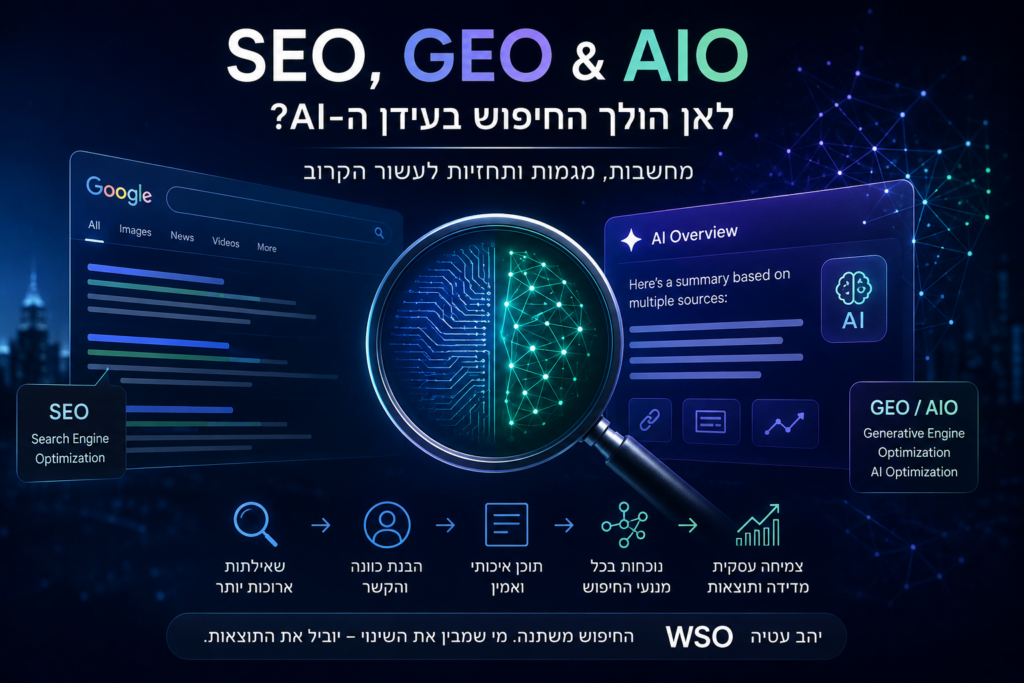
SEO, GEO and AIO: what’s actually changing?
SEO, search engine optimization, is the familiar field of optimizing for search engines.
GEO, generative engine optimization, refers to optimizing the presence of the brand and site in answer engines and AI-based search systems.
AIO can refer to AI optimization or to AI Overviews optimization, depending on the context. In practice, I’m less interested in the exact name and more in the change it represents: search engines are starting not just to display a list of results, but also to try to understand the question, gather information from different sources and build an answer.
And that changes the game.
But it doesn’t erase the old game.
Google still needs to understand sites, index them, assess their quality and trustworthiness and decide when to show them. So technical SEO, site architecture, quality content, internal links, authority, data and measurement aren’t disappearing.
They’re simply becoming part of a bigger system.
In my opinion, the future is search visibility
I think the term “SEO” will be less accurate in a few years.
Not because it will disappear, but because it will be only part of the picture.
A business doesn’t really want “first place on Google”.
It wants to appear when a potential customer searches for a solution it provides.
Sometimes that will be in the organic result.
Sometimes in an AI Overview.
Sometimes in an AI system’s answer.
Sometimes in a map result, a video, a review, a forum or a product page.
So the broader goal, in my eyes, is:
Search visibility.
In other words, a business’s ability to be present wherever people search for information, compare options and make decisions.
Search is going to get longer
One of the changes I expect to see in the coming years is a significant lengthening of the search tail.
People no longer have to write:
“running shoes”
They can write:
“Which running shoes should a beginner who runs three times a week buy?”
And that’s a huge difference.
The second query contains intent, context, need and constraints.
AI systems encourage exactly this type of interaction. Instead of trying to guess which three keywords will describe the problem, the user can simply explain to the search engine what they want in natural language.
So I estimate that the long tail of search will in future be significantly longer than what we’ve grown used to.
15 examples of how the long tail can get longer
1. Insurance
Short search:
car insurance
Long search:
Which car insurance is best for a 35-year-old driver with a new car who drives little and has a record with no accidents?
2. Computers
Short search:
laptop for students
Long search:
Which laptop up to 4,000 shekels suits an engineering student who needs to run heavy software but also wants a light computer?
3. TVs
Short search:
OLED TV
Long search:
Which 65-inch OLED TV offers the best value up to 5,000 shekels for movies and PS5?
4. Hotels
Short search:
hotel in Tel Aviv
Long search:
Which hotel in Tel Aviv suits a couple for a weekend with a pool, a good breakfast and parking for up to 1,000 shekels a night?
5. Dentist
Short search:
dentist
Long search:
A dentist in the central region who treats children and has afternoon appointments?
6. Courses
Short search:
SEO course
Long search:
Which SEO course should I take if I already know WordPress and want to start working with clients?
7. Restaurants
Short search:
Italian restaurant
Long search:
A good Italian restaurant in Tel Aviv that’s right for a date and not too expensive?
8. Furniture
Short search:
living room sofa
Long search:
Which corner sofa suits a small living room with a dog and is easy to clean?
9. WooCommerce
Short search:
building a WooCommerce store
Long search:
How much does it cost to build a WooCommerce store in Israel with 100 products, payment processing and shipping?
10. SEO for businesses
Short search:
SEO for a small business
Long search:
How long does it take to promote a new local business’s site on Google, and what needs to be done in the first months?
11. Shipping
Short search:
shipping company
Long search:
Which shipping company offers the best value for a small business that sends only 20 packages a month in the central region?
12. Payment processing
Short search:
payment processing for a website
Long search:
Which payment processing system is best for an Israeli WooCommerce store that sells about 50,000 shekels a month?
13. Vacations
Short search:
vacation in Greece
Long search:
Where in Greece should a couple fly in October if they want beaches and good food and aren’t looking for nightlife?
14. Electrical appliances
Short search:
recommended refrigerator
Long search:
Which 4-door refrigerator is recommended for a family with four children on a budget of up to 8,000 shekels?
15. Professional services
Short search:
Long search:
Who can build me a WordPress site for a small business, including basic SEO, payment processing integration and the option to expand into a store in the future?
These examples illustrate something important: it’s not just about increasing the number of words in the query.
It’s about increasing the amount of information the user gives the search engine.
What does this do to SEO?
It turns classic keyword research into something much more complex.
If in the past we built a list of keywords and mapped them to pages, in the future we’ll also need to understand:
- What is the user trying to achieve?
- What stage are they at?
- What conditions are they setting?
- What sub-questions do they have?
- Which product or service suits their case?
- What will make them trust the answer?
- And what action do they want to take in the end?
In other words, we’re moving from keyword research to intent research.
And that’s exactly where AI can be a tremendous tool for SEO
I don’t think AI’s advantage in SEO will be only in writing articles faster.
That’s the easiest part.
The bigger value will be in analyzing huge amounts of information.
For example, you can take Search Console data, user questions, product pages, Analytics data, site information, customer service questions and sales data and try to identify patterns.
Out of thousands of queries, you can discover dozens or hundreds of groups of intents.
And then you can build a content architecture around them.
Query → intent → suitable page → content → product/service → internal linking → conversion
That’s already an SEO system.
Not a collection of articles.
Will people still click through to the site?
In my opinion, yes, especially when it comes to action intent.
If a person asks:
“What’s the difference between OLED and QLED?”
they can get an answer directly from an AI engine.
But if they ask:
“Which 65-inch OLED should I buy?”
they’re already approaching the commercial stage.
And if they ask:
“Where can I buy this model right now at the best price?”
they already want to take action.
The same is true for a doctor, a hotel, an insurance company, a website builder, a shipping company or any other service.
AI can answer the question, but when the user wants to buy, order, book, compare, leave their details or get a price quote, the business still needs to be there.
So I don’t see a future in which sites simply disappear.
I see a future in which the value of a site visit can be higher, because some informational searches will be closed inside the search engine, while users with action intent will keep coming to the business.
And what will happen to the SEO market?
This is where I think the business forecasts are especially interesting.
Estimates by various research firms point to continued significant growth in the SEO services market over the coming decade. The numbers vary greatly depending on how the market is defined, but some forecasts point to double-digit growth rates.
The reason, in my eyes, is simple: the more complex search becomes, the more expertise businesses need to understand where and how they appear.
AI may reduce the cost of some manual work, but it can also increase the amount of activity that can be carried out.
In other words:
Less time on manual work × more automation × more data × more search channels = a bigger SEO system.
So I don’t think the question is:
“Will SEO die?”
The right question is:
“What kind of SEO will survive and grow?”
In my opinion, generic, cheap SEO will be under pressure.
Technical, strategic, data-driven SEO will be much more interesting.
And what about the website building market?
Here too I’m optimistic.
The fact that AI-based tools let you set up a site faster doesn’t mean every business will stop needing a site.
Quite the opposite.
As the technical cost of building a site falls, expectations rise.
A business no longer wants just a site that works.
It wants a site that’s fast, accessible, mobile-friendly, SEO-optimized, connected to Analytics, connected to a CRM, connected to payment processing, connected to shipping and able to integrate with automations.
The site becomes a layer within a business system.
So I predict that website building will become less of a “development craft” and more of website engineering + marketing infrastructure.
Who will profit from the change?
In my opinion, there will be three main groups.
The first is those who know how to build automated systems at scale.
The second is those who understand SEO, UX, conversion and data, and not just the technical side.
And the third is those who manage to connect all of this to a business result.
The combination of these will be especially powerful.
Website + SEO + AI + automation + analytics
In my eyes, that’s one of the most interesting formulas for the coming years.
My forecast for 2030–2035
I don’t think that in ten years people will stop using Google.
I do think the word “Google” itself will be less important.
The user will simply want an answer.
Sometimes they’ll get it from Google.
Sometimes from ChatGPT.
Sometimes from Gemini.
Sometimes from a system that doesn’t exist yet.
And the question for businesses will be:
Is my brand inside the answer?
That will be one of the most important questions in the world of digital marketing.
So I predict that the term SEO will continue to exist, but its boundaries will blur.
SEO will gradually become part of a broader system of search visibility.
And what does this mean for businesses?
A business that wants to succeed in search over the coming decade will need to think less about “how do I write another article” and more about “how do I become the best source in my field”.
That means a strong site.
That means quality content.
That means trustworthy information.
That means real experience.
That means a brand.
That means data.
That means the right technical structure.
And it means understanding how search engines and AI systems interpret the business.
My conclusion
I don’t think we’re at the end of the SEO era.
I think we’re at the end of an overly narrow definition of SEO.
Search is going to be more natural, longer, more personal and context-based.
The user won’t necessarily type two words and press Enter. They’ll hold a conversation with the search engine.
And that creates a new opportunity.
Whoever knows how to understand this conversation, map the intents behind it, build the content and the site around them, measure the result and do all of this through automation will be able to create a significant advantage.
For me, that’s why I don’t look at AI as something that kills SEO.
I look at it as the thing that can make SEO much bigger, much more technological and much more interesting.
Search isn’t disappearing. It’s just starting to understand us a little better.
Yahav Attia
SEO, Automation & Digital Strategy