
Cost per click (CPC): the complete guide that reveals the secrets behind winning campaigns
In the fast-paced world of digital marketing, every click is worth money. But how much? It’s a basic yet critical question that occupies campaign managers, business owners and anyone involved in paid advertising. The metric that gives the most precise answer is cost per click (CPC). Beyond being a mere number, CPC is a deep window into the complex mechanisms that determine how efficient you are in the world of advertising.
In this article, we’ll dive into the heart of the topic, break down all the calculations, explain the hidden factors that affect the price, and present advanced strategies that will let you lower your CPC and dramatically improve your campaigns’ performance. Whether you’re new to the field or an experienced marketer, this guide is designed to give you practical tools and solid knowledge to succeed.
Part A: the basics – what is CPC and how do you calculate it?
1. A simple but precise definition
Cost per click is nothing more and nothing less than the average amount you pay the advertising platform (like Google or Facebook) every time a user clicks on your ad. It’s the most popular model in paid advertising, and also the most logical: if nobody clicks on your ad, you don’t pay for it. This model ensures you pay only for traffic to your site, unlike other models where you pay for exposure alone, such as CPM (cost per thousand impressions).
2. The formula everyone needs to know
Calculating CPC is simple and direct, proving that behind all the complex data lies basic math.
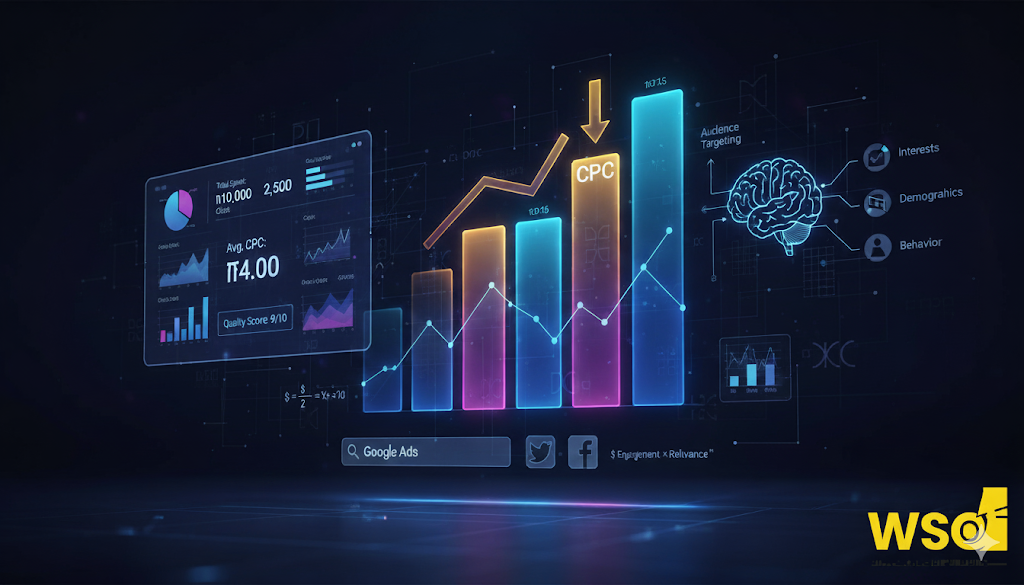
An illustrative example: Suppose you launched a campaign on some advertising platform. At the end of the month, the campaign report shows you spent 10,000 NIS. From that investment, you received 2,500 clicks. Your campaign’s average CPC is:
This means that, on average, each click cost you 4 shekels. On its own, this number doesn’t say much, but it’s the basis for every business decision you’ll make from here on.
Part B: the hidden mechanism – factors that affect CPC
CPC isn’t a fixed number. It changes constantly and is influenced by countless parameters, some under your control and some not. Understanding this mechanism is the key to real optimization.
1. Competition and industry As in any free market, the price per click is determined by supply and demand. In competitive industries like insurance, finance or law, there are many advertisers, all competing for the same keywords or audiences. As a result, bids rise, and CPC can reach especially high amounts – tens or even hundreds of shekels for a single click. In niche or new industries, by contrast, competition is lower, and CPC can be significantly lower accordingly.
2. Quality Score This may be the most important factor affecting CPC, especially in Google Ads. Quality Score is a rating from 1 to 10 that Google gives each keyword in a campaign. It reflects how relevant and high-quality your ad is for the searcher. A higher Quality Score leads to a higher ad rank and at the same time lowers your cost per click. It’s made up of three main components:
- Expected CTR: Does Google expect your ad to be attractive enough to get clicks?
- Ad relevance: Does the keyword match the ad text?
- Landing page experience: Is your landing page relevant to the search, fast and easy to use?
More metrics
3. Ad position and Ad Rank Your ad’s position on the results page directly affects CPC. Higher positions, like first place, usually require a higher bid. However, ad rank isn’t determined only by the price you’re willing to pay – it’s the product of Quality Score and your bid.
This formula proves that even if your competitor bids a higher price, an excellent Quality Score can push you above them and make you pay less.
4. Bidding strategy On most platforms, you can choose between several bidding strategies. Manual bidding gives you complete control but requires ongoing optimization. Automated bidding strategies, like “Maximize clicks” or “Maximize conversions”, give the platform’s algorithm the freedom to set bids for you, which can affect your daily CPC.
Part C: differences between advertising platforms
Although the concept of CPC exists on every platform, the way it’s calculated and the deciding factors differ fundamentally. Understanding this is essential for running successful campaigns on any platform.
- Google Ads: On Google, advertising is based on user intent. People are looking for a solution, so your ad must be highly relevant to what they typed. The main competition is over keywords, and Quality Score is the deciding factor.
- Facebook Ads: On Facebook, advertising is based on behavior and interests. People weren’t looking for you, but they may be interested in your product or service. Here, ads are “pushed” to the target audience. CPC on Facebook is influenced more by the audience’s level of engagement with the ad (likes, shares, comments) and by the quality of the creative (image/video). The more interesting the ad and the more interaction it generates, the lower the CPC.
- TikTok Ads and LinkedIn Ads: On TikTok, CPC is relatively low for awareness campaigns, but may rise dramatically for conversion campaigns. On LinkedIn, by contrast, competition for professional, targeted audiences is high, making CPC more expensive, especially in B2B (business-to-business) campaigns.
Part D: practical strategies for lowering CPC
Ultimately, every marketer’s goal is to lower CPC as much as possible without hurting traffic quality. Here are some practical tips:
- Improve your Quality Score (in Google Ads):
- In-depth keyword research: Use precise, relevant keywords, and avoid keywords that are too general.
- Writing winning ads: Make sure the ad text speaks directly to the user’s search and includes a clear call to action.
- Landing page optimization: The landing page must be completely relevant to the ad, fast to load and user-friendly.
- Precise audience targeting (in Facebook Ads):
- Create relevant audiences: The more precisely you segment your audience (age, location, interests), the more your ad will reach people it’s relevant to, increasing engagement and lowering CPC.
- Ad testing (A/B testing): Test different versions of ads with different creative and copy to identify which version delivers the best results.
- Smart bid management:
- Start with a low budget: Don’t start with high bids. Start low, learn from the data, and increase gradually only when necessary.
- Constant analysis: Analyze campaign reports regularly. Identify expensive keywords or audiences that don’t deliver results, and remove them from the campaign.
In summary, CPC isn’t just a metric – it’s a strategic tool that should be managed wisely. With a deep understanding of the calculations, the deciding factors and the differences between platforms, you can run smart campaigns, save money and improve your return on investment.
Sounds complicated? We at WSO specialize in campaign management. Click here for a free, no-obligation initial consultation.
Has calculating CPC helped you improve your campaigns’ performance? Share with us in the comments!